
who can stop you if you are "REAL YOU"

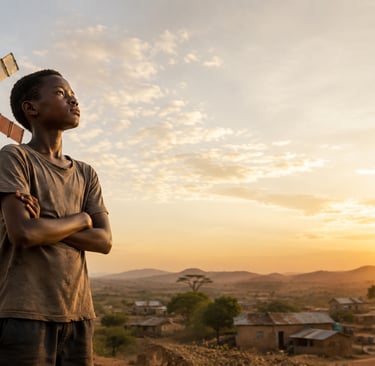
The Boy Who Built Wind from Broken Things
The real story of William Kamkwamba — and the power of refusing to stay defeated
There are two kinds of poverty.
One is the poverty of money.
The other is the poverty of imagination.
Poverty can stop your schooling, limit your food, darken your home, and make every dream look far away. But imagination poverty is worse. It convinces a person that nothing can change.
William Kamkwamba was born in Malawi, a small country in southeastern Africa. He was not born into comfort, privilege, or easy opportunity. He grew up in a farming family, in a village where electricity was not something people casually enjoyed. Darkness came early. Hunger was real. School fees mattered. Rain mattered. Crops mattered. Survival was not an idea discussed in motivational seminars. It was daily life.
When William was fourteen, Malawi suffered a severe famine. His family could no longer afford his school fees, and he had to drop out of high school. For many young people, that would have been the end of the story. No school. No money. No network. No technology. No powerful family. No easy escape.
But William did something that separates creators from complainers.
He kept learning.
Not in a beautiful classroom. Not with a laptop. Not with online courses. Not with perfect English explanations from professors. He began going to a small village library. There, he looked through science books and found a textbook called Using Energy. He could not fully understand every word, but one picture changed his life: a windmill.
Most people would have looked at that picture and moved on.
William looked at it and asked a dangerous question:
Why not here?
That question is the beginning of every great human rise.
Why not my village?
Why not my family?
Why not me?
He had no proper instructions. He had no engineering degree. He had no factory-made parts. He had no investor. But he had wind. He had curiosity. He had scrap. And he had a mind that refused to remain unemployed simply because school had stopped.
William began collecting broken and discarded materials: bicycle parts, PVC pipe, car parts, scrap metal, wood, and anything he could repurpose. To others, these were useless things. To him, they were pieces of a future. WIRED reported that he built his machine using materials such as PVC pipe, bicycle and car parts, and blue gum trees.
That is the first major lesson for young people:
The world may call something waste. A creator sees raw material.
A lazy student sees no coaching and says, “I cannot compete.”
A serious student sees free lectures, old books, and discipline — and starts.
A weak entrepreneur sees no capital and quits.
A real entrepreneur sees a small problem, builds a crude prototype, and improves.
William’s first goal was not fame. It was not a TED Talk. It was not a movie. It was simple and deeply human: he wanted light. He wanted electricity so he could read at night. He wanted to help his family escape darkness.
This is why the story is powerful. His dream was not born from ego. It was born from need.
But need alone is not enough. Millions suffer need. Very few convert need into invention.
William worked. He tested. He failed. He adjusted. He climbed towers that were not professionally engineered. He faced village suspicion and ridicule. Some people reportedly thought he was mad. That is normal. When a person builds something others cannot understand, the first response is often mockery.
The crowd laughs before it applauds.
That is another lesson for young readers:
If you are doing something meaningful, do not expect early applause. Expect confusion. Expect doubt. Expect criticism from people who have never built anything.
Eventually, the windmill worked.
It produced electricity for his family’s home. Later, the project grew. According to WIRED, his windmills eventually helped light bulbs, power radios and a television, charge phones, and pump water for fields and household use.
Pause here.
A boy who was forced out of school because of poverty used a library book and discarded parts to bring electricity and water solutions to his family and community.
That is not motivational decoration. That is human power.
William’s life changed when his invention began attracting attention. Journalists came. His story spread. In 2007, he spoke at TEDGlobal in Tanzania, and support followed for his education and projects. WIRED notes that his TED appearance helped bring attention and funding support, while Dartmouth Engineering later described him as a Dartmouth undergraduate who had built a homemade windmill at age fourteen to power his family’s home.
But do not misunderstand the story.
TED did not create William Kamkwamba.
Recognition came later.
The real William was created in the silent season — when he was out of school, hungry for knowledge, reading books he could barely understand, and building with broken parts while others doubted him.
That is where success is actually made: before the world notices.
Later, William’s story became the bestselling memoir The Boy Who Harnessed the Wind, co-authored with Bryan Mealer, and it was adapted into a Netflix film directed by Chiwetel Ejiofor. The Moving Windmills Project states that the book has sold more than one million copies and has been translated into nearly twenty languages.
He also continued his education and graduated from Dartmouth College in Environmental Studies, according to the Moving Windmills Project.
But the greatest part of William’s journey is not that the world discovered him.
The greatest part is that he discovered his own agency.
He discovered that a poor boy can still think.
A dropout can still learn.
A village can still innovate.
A broken bicycle can still become a machine.
A book can still become a bridge.
A rejected child can still become a global example.
This story matters today because many young people are drowning in excuses.
“I do not have the right college.”
“I do not have money.”
“I do not speak perfect English.”
“I do not have contacts.”
“I am from a small town.”
“I failed once, so maybe I am not capable.”
Some excuses are real. Let us not pretend they are imaginary. Poverty is real. Lack of access is real. Bad schooling is real. Family pressure is real.
But here is the hard truth:
Your disadvantage explains your starting point. It does not automatically decide your destination.
William Kamkwamba did not wait for a perfect system. He used an imperfect library.
He did not wait for perfect tools. He used scrap.
He did not wait for people to believe in him. He built until belief became unavoidable.
That is the mindset this generation needs.
Not empty positivity.
Not social media pretending.
Not fake luxury.
Not motivational noise.
The world needs young people who can look at broken conditions and still ask:
What can I build from this?
William’s story is not only about a windmill. It is about intellectual courage. It is about self-education. It is about refusing to let poverty steal curiosity. It is about using knowledge not merely to pass exams, but to solve real problems.
For a student, the lesson is simple: do not stop learning just because the classroom is weak.
For a young entrepreneur, the lesson is sharper: do not wait for perfect funding before building your first version.
For a struggling family, the lesson is deeper: one curious child can change the direction of a household.
For the world, the lesson is unforgettable:
Innovation does not always begin in laboratories. Occasionally, it begins in hunger, darkness, and a small library.
William Kamkwamba harnessed the wind.
But before that, he harnessed something greater.
He harnessed his own mind.
And once a young person learns to do that, poverty may delay them, failure may test them, and society may laugh at them — but they are no longer easy to defeat.
When you cannot afford an opportunity, build it.
What broken thing in your life — failure, poverty, rejection, lack of resources, or lost time — can become raw material for your next rise?
Disclaimer
This article is based on publicly available information, interviews, published reports, and biographical sources about William Kamkwamba. The story has been written in a narrative and inspirational style for educational and motivational purposes. The image used is symbolic and AI-generated; it is not an actual photograph of William Kamkwamba.